Thursday, April 30, 2026

Thursday of the Fourth Week of Easter

 Lectionary: 282

When Jesus had washed the disciples’ feet, he said to them:
“Amen, amen, I say to you, no slave is greater than his master nor any messenger greater than the one who sent him.
If you understand this, blessed are you if you do it.
I am not speaking of all of you. I know those whom I have chosen.


So why doesn't the Lord choose everyone? The perennial question never goes away. It's the same question the disciples asked of Jesus, "Will many be saved?"

He gave precisely the right answer, "Strive to enter through the narrow gate?"

His was a gentler response than mine, "Who's asking? Who do you think you are that you can ask such a question of God?" 

When Peter asked the Risen Lord about the Beloved Disciple whom we call John, Jesus replied, "What is that to you?" and, "Follow me!" 

When He says in today's gospel, "I know whom I have chosen," we might respond as the disciples did to another of his remarks, "Is it I, Lord?" But a better response might be, in reference to today's gospel, "How do I pretend to be greater than the master?" or, "How do I excuse myself from the sacrifice of the cross? How do I dare to ask God questions and expect an answer?" 

Job dared to ask and was rebuked for it: 

Who is this who darkens counsel 
with words of ignorance? 
Gird up your loins now, like a man; 
I will question you, and you tell me the answers! 
Where were you when I founded the earth? 
Tell me, if you have understanding. 
Who determined its size? Surely you know? 
Who stretched out the measuring line for it? 
Into what were its pedestals sunk, 
and who laid its cornerstone  
While the morning stars sang together 
and all the sons of God shouted for joy? 

I've just sat through another homily assuring me I should not fear the Lord, despite whatever the Bible says. "Our sweet and adorable God wants only to be loved."
Please, spare me the treacly gospel. 

"The fear of the LORD is the beginning of wisdom; prudent are all who practice it." (Psalm 111:10)

Anyone who is not terrified by holiness must have steeled himself against ordinary human feeling. Holiness, might, majesty, authority: all of these belong to the One who has won the right by his suffering and death. 
"Worthy is the Lamb that was slain to receive power and riches, wisdom and strength, honor and glory and blessing.”  (Revelation 5:12)

Learning to practice the Fear of the Lord as the Bible urges us, we come to know the enormous worth our God has invested in us. Without that Fear we cannot begin to appreciate God's sacrifice, nor can we begin to practice the sacrificial life the Lord offers to us so freely. It is a truly good life although the world might not notice or care. 

Hearing how the Father loved him and was pleased with him, Jesus fled into the desert and was tested for forty days and forty nights. At the end of that period he could rebuke Satan, "‘You shall not put the Lord, your God, to the test!" and, "The Lord, your God, shall you worship and him alone shall you serve."

Those who fear the Lord fear no one else.


Wednesday, April 29, 2026

Memorial of Saint Catherine of Siena, Virgin and Doctor of the Church

 Lectionary: 281

Jesus cried out and said,
“Whoever believes in me believes not only in me but also in the one who sent me, and whoever sees me sees the one who sent me.
I came into the world as light,
so that everyone who believes in me might not remain in darkness.

Our daily readings of Saint John's gospel have brought us rather abruptly to a transitional passage between the Book of Signs (John 1:19-12:50) and the Book of Glory (John 13-20:31). The Book of Signs ended with the most astonishing and wonderful sign, the call of Lazarus back to life. 

But because real life in this world doesn't end in a Happily Ever After, there followed the conspiracy against Jesus, a prophetic woman anointing his feet, and his going into hiding. (12:36) That withdrawal from public view prepares us for the stunning revelations that will follow. 

But as we enter the Book of Glory we hear the Lord crying out in today's gospel. The cry comes not from hiding but rather, is a summation of everything he has said and done to date. If we have understood the signs we are prepared for the glory to come. 

First, with this summation, we should understand the Lord is coming from the One who sent him. He is God the Father and Jesus is the Beloved Son (3:16) who is given to death to bring us to life. If we know nothing else about Jesus, we should know he is the Son of God. 

Secondly, he has come "...so that everyone who believes in me might not remain in darkness." Unless we believe in Him we remain in darkness. 

With this summation, the Lord also insists that he "...did not come to condemn the world but to save the world." He offers us not like a consumer's choice between Cheerios and Wheaties, or Ford and Chevrolet. This is life or death; and no one can not choose. Moses had made the same warning to the Israelites in the Book of Deuteronomy

I have been reminded recently, in my reading about the Nazi murder of Jews, that every age and every society is violent. But a civilized society successfully removes its violence from the daily experience of most citizens. It is confined to certain parts of the city, or to jails and prisons. Police are supposed to represent the thin blue line between those bounded neighborhoods. Those who live on the safe side of that line might not know, and probably don't want to know, what is happening on the other side. Some will happily chirp that "I don't have an enemy in the world!" They do have many enemies; but they are faceless and removed. 

The safe also know, and should never forget, the threat. They too can fall out of their safe zone into violence. It's never far away. Alcohol, drugs, pornography, scamming merchants, insinuating ideologues, scheming politicians, and compromising pastors: all search for prey among God's sheep. Families are betrayed by adultery and divorce. Tragically, some helpless people with schizophrenia are also led into those terrible places where their loved ones cannot reach them.  

There are enemies within and enemies without, and our only real hope is faith. The cross of Jesus stands on the dividing line between these two worlds. The wicked and the redeemed see Our Savior crucified. Gazing toward the cross we see brethren and sistren across the line, and recognize both invitations to salvation and damnation. 

Our choice of faith in God's Son must be made daily, and many times a day; it must be intentional and fervent. Half-measures do nothing. 

You who love the Lord, hate evil!
The Lord protects the lives of his consecrated ones:
  he will free them from the hands of sinners.
A light has arisen for the just,
  and gladness for the upright in heart.
Rejoice, you just, in the Lord
  and proclaim his holiness.
Psalm 97:10-12 -- Grail Version


Tuesday, April 28, 2026

Tuesday of the Fourth Week of Easter

 Lectionary: 280

My sheep hear my voice;
I know them, and they follow me.
I give them eternal life, and they shall never perish.
No one can take them out of my hand.
My Father, who has given them to me, is greater than all,
and no one can take them out of the Father’s hand.
The Father and I are one.”

During troubled times -- which is most of the time -- the faithful listen for the Word of God. It comes to us as to a child at night when a father says, "I am here; I am not going away; you are mine; no one will harm you."

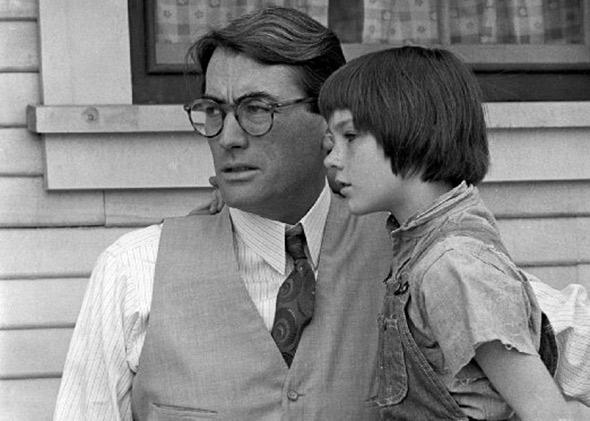
His voice speaks with authority and we welcome that authority. I think of Scout as she and her father Atticus watched their home burn. "It's not time to worry yet." he said. And so she didn't. 

Hearing that word and realizing how anxious we remain, we must turn inward and ask, "Where does that anxiety come from?" We may need some counseling or spiritual direction. (I've had plenty of both.) And then, perhaps after discovering its source, we must turn again to prayer and decide to trust in God. 

Gregory Peck and Mary Badham
in the 1962 film version of
To Kill a Mockingbird.
It's a decision we make, and it might feel like that of Saint Peter when he got out of the boat and walked on water. He was as surprised as anyone when one step followed another and he remained above the violent currents that raged beneath him. So long as he kept his eye on the Lord he did just fine. And when he failed, the Lord asked him, perhaps with a knowing smile, "Why did you doubt?"  

We too must walk on water in simple obedience to the Lord's command. When he says, "Come!" we do it -- again and again and again. And we learn to do it. We learn to trust our instincts because they are formed and disciplined by the Holy Spirit. We learn to trust our Catholic faith despite the controversies that divide some members against others, and even separate bishops from the Pope. We learn that it's okay when we don't know how this trouble will end. In fact, it will never end until the Lord himself returns on that Great and Glorious Day.

Faith heals our chronic anxieties along with a host of other ills. Seeing the end of modernity, nations, and the binding force of religion, we turn our gaze back to the Lord who comes for us: 
The sea was stirred up because a strong wind was blowing.
When they had rowed about three or four miles, they saw Jesus walking on the sea and coming near the boat, and they began to be afraid.
But he said to them, “It is I. Do not be afraid.”
They wanted to take him into the boat, but the boat immediately arrived at the shore to which they were heading. (John 6:18-21)


Monday, April 27, 2026

Monday of the Fourth Week of Easter

 Lectionary: 279

The Apostles and the brothers who were in Judea
heard that the Gentiles too had accepted the word of God. So when Peter went up to Jerusalem the circumcised believers confronted him, saying,
‘You entered the house of uncircumcised people and ate with them.”

Saint Luke vividly described the troubles of the early Church as they obeyed the Lord's command to "be my witnesses in Jerusalem, throughout Judea and Samaria, and to the ends of the earth.”

First, there was the violent resistance by the same Jewish leaders who had arranged the death of Jesus by crucifixion and then there was serious division within the Church. Many of the original disciples of Jesus and their new converts loudly opposed the inclusion of gentiles.

Despite his readiness to heal gentiles and members of their families, Jesus had not announced the Kingdom of God in gentile territory, nor had he directed his disciples to go beyond the Jewish towns and villages. He had come to fulfill the Law which had been given to Moses, but the innumerable laws, customs, and practices of the gentile nations seemed beyond his ken. 

It would be many centuries before Enlightened philosophers would suggest that Christian symbols belong to everyone because they resemble the archetypes of dreams and pagan religions.

He also showed that Christianity can be compared to other religions. I frankly doubt it; the apparent resemblances are laughably superficial.

But the challenge of inclusion remains forever in the Church. How far should we go with acculturation when newly baptized persons bring their familiar rites, symbols, clothing, and songs into Catholic worship? When I suggested that we might soon welcome Hispanic Catholics to our parish one lady said, "Please, Father, we have enough trouble already."

But the witness of Saint Luke, and the scriptures in general, assure us that we've always had trouble, and always will. We should not be surprised about that. God gives us His Holy Spirit to help us deal with, and grow through, trouble. If we have no trouble, we don't need the Holy Spirit; and then where will we be?

Our attitude toward trouble should be the same as that toward strangers, Welcome. They will, of course, experience profound changes in their hearts and minds, attitudes and habits, as the Spirit recreates them in God's image. Familiar as we are with that process, we also welcome it in ourselves again and again, because we are his, 
"...witnesses in Jerusalem, throughout Judea and Samaria, and to the ends of the earth."


Sunday, April 26, 2026

Fourth Sunday of Easter

 Lectionary: 49

"Amen, amen, I say to you,
whoever does not enter a sheepfold through the gate
but climbs over elsewhere is a thief and a robber.
But whoever enters through the gate is the shepherd of the sheep.
The gatekeeper opens it for him, and the sheep hear his voice,
as the shepherd calls his own sheep by name and leads them out.

A woman once consulted with me about her lover; he was continually asking for money and she had barely enough to live on. Since she had a speech impediment, was not Catholic, and our backgrounds were quite different, it took several minutes to realize her lover was a televangelist. She was convinced that a TV image loved her intensely and desperately needed her help. 

Sadly, I don't think I dislodged her loyalty to that "thief and robber," who by way of the television, had climbed over the fence into her innocence. But I hope and believe she has found her reward with the Lord by now, and he has gone to his preordained destiny.

Not long after I was ordained the world was stunned by the death of over nine hundred Americans in a South American jungle clearing. Convinced that Jim Jones was their savior, they drank cyanide rather than return to life in America. Hearing the story, I thanked God that I am a Catholic priest; and that, should I ever go off the deep end, a duly appointed authority of the Church would remove me from office. 

Scam artists, like the televangelist and Jim Jones, exploit our sinful failings. They play on their victims' greed, loneliness, boredom, and anxieties. They have nothing to offer to people who are content with what they have, and rely on God's promises to support them through uncertain times. 

In today's first reading, Saint Peter reminded the people of Jerusalem of how they had demanded that Rome should crucify the one whom "God has made both Lord and Christ." They were the people to whom God gave Sadducees, Herodians, and Pharisees as leaders to oppress them because God gives a nation the leaders they deserve. As Saint Paul said to the Christians in Rome: 
"There is no authority except from God, and those that exist have been established by God." 

Horrified as they heard Saint Peter, and remembering the madness of that Passover fifty days before, they asked, 
"What are we to do, my brothers?"
Peter said to them,
"Repent and be baptized, every one of you,
in the name of Jesus Christ for the forgiveness of your sins;
and you will receive the gift of the Holy Spirit.

Our first response to the Good News is repentance for our sins. We turn away from the concupiscence which scammers exploit. We welcome the Lord to fill those empty places which are filled by consumer goods and false lovers. 

Our first response to God's Word is penance for our sins; it is not to tell everyone how wonderful we feel about having gone to the church, Cursillo, or a twelve step meeting. Penance is not joining an exciting church; it's not listening to a marvelous preacher or hearing an extraordinary choir. It is not telling others how happy we are that we have found Jesus. It is certainly good to praise God in every circumstance, but that does not exempt us from discovering, recognizing, owning, admitting, and atoning for our sins. Nor does it give us a pass from making significant changes to our attitudes, habits, speech, and actions. 

God's word is a two-edge sword, as we read in the Letter to the Hebrews: 
Indeed, the word of God is living and effective, sharper than any two-edged sword, penetrating even between soul and spirit, joints and marrow, and able to discern reflections and thoughts of the heart. No creature is concealed from him, but everything is naked and exposed to the eyes of him to whom we must render an account. (Hebrews 4:12-13)

When we set out on the Gospel Road to salvation we should understand it's an endless road and will cost more than we're prepared to pay. But we will be notified in our hearts and minds when it's time to pay more, and we'll know what it cost. And by God's grace we will be ready to pay it, although we can hardly imagine that now. 


Saturday, April 25, 2026

Feast of Saint Mark, evangelist

 Lectionary: 555

“Go into the whole world
and proclaim the Gospel to every creature. Whoever believes and is baptized will be saved; whoever does not believe will be condemned...
...they went forth and preached everywhere, while the Lord worked with them and confirmed the word through accompanying signs.

As I understand it was one of Europe's greatest philosophers, Hegel, who assured his fellow citizens that they didn't have to take the Word of God too literally or too seriously. He pointed to the springtime, for instance, as a time of renewed vitality among living things, and that's what resurrection means. It's not, according the philosopher, about someone coming back from the dead and living forever; it's rather the undying, resurgent vitality (geist) which exists briefly in this or that organism. It holds dead matter in a living embrace for a while; and then moves on to form other organisms which also return to the earth from which they are made. In other words, you won't live forever but your spirit will. And so Easter is well represented by flowers which produce seeds, fertile rabbits, and eggs. 

Hegel admitted that everything dies and no individual is finally saved from that. But life is worth living despite its brevity, especially if you're wealthy, secure, educated, and esteemed by your peers. 

However, the Gospel of Mark takes the Word of God very seriously, and impresses upon the Church its responsibility to every living creature. If it fails, if people do not know the Lord, they are not saved; nor are they saved if they refuse to hear.  

The Gospel comes to us in the form of a cross, comprising an upright and a crossbeam. Both are necessary blessings, neither can be ignored. The horizontal beam extends to the entire world, the vertical upright reaches from the fathomless depths of every human heart to the infinite reaches of heaven. 

But our attention seems to shift back and forth between the vertical and horizontal, Sometimes our attention is fascinated by our duty to praise God and the call to personal penance; sometimes we want to invite everyone who can possibly hear or welcome the Good News. 

Reflecting on the post-war Church and the Second Vatican Council, Pope Benedict XVI suggested that the Traditional Latin Mass represents the mysterious vertical beam; and the vernacular Mass represents the horizontal liturgy which is accessible to everyone. Both can and do speak to everyone who will listen. In both cases, our duties are serious. 

It is wonderful to see surprising numbers of people entering the Church this year through the Order of Christian Initiation of Adults in Europe and North America. We can suppose that millions of people are disenchanted with the false promises of this world with its endless entertainment and relentless exploitation of human and natural resources. Human beings instinctively know we deserve better than what the world offers. We know too, that "our hearts are restless until they rest in God." 

As we celebrate the Feast of Saint Mark, the shortest and perhaps darkest of the Gospel, we welcome the brilliant light it sheds on our call to holiness and our mission to announce the Gospel to every creature. 


Friday, April 24, 2026

Friday of the Third Week of Easter

 Lectionary: 277

“Amen, amen, I say to you,
unless you eat the Flesh of the Son of Man and drink his Blood,
you do not have life within you.
Whoever eats my Flesh and drinks my Blood
has eternal life,
and I will raise him on the last day.
For my Flesh is true food,
and my Blood is true drink.
Whoever eats my Flesh and drinks my Blood
remains in me and I in him.


The Lord's teaching about the Eucharist cannot be any simpler or more straightforward. In the passage above he uses an insistent negative-positive parallelism; making a negative statement and then restating it again in its positive form: "unless you eat..." and "whoever eats...." 

And then He makes the positive statement a second time to bring it home, "Whoever eats my Flesh and drinks my Blood remains in me and I in him."

Anyone who wants further explanation is stalling. Our response may be wonder, gratitude, and eager desire to receive these precious gifts. It may be Eucharistic processions, faithful attendance at Sunday and daily masses, private hours in silent adoration before the tabernacle; genuflection in church, and a sign of the cross when passing a church. There should be no further questions about how this can happen. We really have better things to do; and analyzing the Blessed Sacrament is utterly pointless!

Hearing the story of Saint Paul's conversion on the same day as the Lord's teaching about the Eucharist contributes to our reflection. The Lord challenged the young, violent Pharisee, "Saul, Saul, why are you persecuting me?" and again, "I am Jesus, whom you are persecuting."

Saul had never seen the Lord before his crucifixion; he knew him only by hearsay, and was persecuting only disciples of the Lord. When the heavenly voice demanded, "Why are you persecuting me?" the Speaker was clearly taking the attacks personally. And he didn't like them. 

Paul would eventually realize that any attack on a Christian is an attack on the Body of Christ, regardless whether the incident happens in Jerusalem, Damascus, or Rome. He would also understand that if one part of the body suffers the whole body suffers:
But God has so constructed the body as to give greater honor to a part that is without it, so that there may be no division in the body, but that the parts may have the same concern for one another. If [one] part suffers, all the parts suffer with it; if one part is honored, all the parts share its joy.
Now you are Christ’s body, and individually parts of it.

Any understanding of the Eucharist must include that appreciation for all those who eat the Flesh and drink the Blood of the Lord. If a Catholic immigrant is arrested and imprisoned despite their innocence, every Catholic is attacked and feels the pain of it. The Church cannot ignore these assaults on our Communion. Wherever Catholics are terrified of the government or of their neighbors, we feel the threat because we share their faith in God. And we're too familiar with hostility not to understand where it comes from.   

Martyrs of every century bear witness to the challenge of believing in Jesus. Those who feel no immediate danger should pray that we might be found worthy of their companionship. The cost of discipleship is dear, and must be paid. 

If eating His Flesh does not remind us of that, drinking His Blood surely will. 


Thursday, April 23, 2026

Thursday of the Third Week of Easter

 Lectionary: 276

When they came out of the water,
the Spirit of the Lord snatched Philip away,
and the eunuch saw him no more,
but continued on his way rejoicing.

There are not many references to eunuchs in the Bible; the word appears only thirteen times, and five of those refer to Saint Philip's encounter with the Ethiopian official. 

Without using the word, Deuteronomy 23:2 specifically states that "No one whose testicles have been crushed or whose penis has been cut off may come into the assembly of the LORD." The ruling may have been appropriate for rural hill people in their small villages, but with international trade, advancing civilization, and a more stratified society. including aristocrats, commoners, and slaves, eunuchs appeared and found their purpose. The practice of castration of young males has been widespread throughout the world. 

Even in Christians nations, some talented boy singers have been castrated with the promise of a future as castrati. Operatic parts were written for them and their music was often glorious. If you've never heard Gluck's Orpheo ed Euridice, written specifically for Gaetano Guadagni, a castrato, you owe it to yourself to hear that marvelous opera. 

Despite the Mosaic law, the Book of Isaiah (56:3) opened the temple to devout gentile eunuchs who loved the LORD: 
Let not the foreigner say, when he would join himself to the LORD, "The LORD will surely exclude me from his people"; Nor let the eunuch say, "See, I am a dry tree."

Written after the Babylonian exile by urban prophets, "Third Isaiah" recognized the possibility that anyone might recognize our God as Lord of the Universe and worthy of universal praise. 

Until recently, eunuchs and castrati seemed an ancient, peculiar, and rather barbaric thing of the past. The last of them, Alessandro Moreschi, died in 1922. However, the question of admission to the faith has reappeared under the heading of transsexuality. Although the Catholic Church vigorously opposes the practice of any attempt to alter sexual identity with pharmaceuticals and surgery, we are also hearing of many unfortunate persons who have chosen that unwise course, and now regret it. 

I met a septuagenarian in the VA who had the surgery perhaps forty years ago, and regretted it, although he still saw himself as gay. The old psychiatric patient had never decided what he is, and lived in perpetual confusion between the demands of his companion for a wife and the desire of his daughter for a father. I listened sympathetically to his unhappiness and reminded him of his original Catholic faith. He can still regret, repent, and return; the door is still open. 

We hate the sin; we love the sinner. God knows we have all, without distinction, sinned; and we know how deceitful any society can be. America's, perhaps, more than most. We thank God continually for the open doorway of Sacraments which restore us to grace. 


Wednesday, April 22, 2026

Wednesday of the Third Week of Easter

 Lectionary: 275

Everything that the Father gives me will come to me,
and I will not reject anyone who comes to me,
because I came down from heaven not to do my own will
but the will of the one who sent me.
And this is the will of the one who sent me,
that I should not lose anything of what he gave me,
but that I should raise it on the last day.

Saint Peter urged his readers to, 
"Come to him, a living stone, rejected by human beings but chosen and precious in the sight of God, and, like living stones, let yourselves be built into a spiritual house to be a holy priesthood to offer spiritual sacrifices acceptable to God through Jesus Christ.

Today's gospel reminds us that Jesus has come to us because the Father sent him, and the Father has also gathered us to Jesus. We come to Him because the Holy Spirit came to us and spoke to us in many and various ways, and we are so inspired we cannot help but come to him. As He said, "When I am lifted up, I will draw all things to myself." 

Often I meet people who, realizing how they failed to come to the Lord as parents with children, now intend to bring their adult children to the Lord. But they have hardly turned aside from their former way of life and have yet to uproot many attitudes that have no place among God's people. I may not be their pastor or spiritual director, but I feel obligated to say, "Start with yourself; don't wait for them." 

I also hear many anxious complaints about Trump's War, the politics in Washington DC, and the troubles of our society. There is a simple way to address those issues: Calculate how much time you watch and listen to the news, and then spend that much and more time in prayer: 
"Come to him, a living stone, rejected by human beings but chosen and precious in the sight of God."

Protests are good things, letters to the editor and to Congress can help, voting in local elections and referendums is necessary, getting involved in local politics is very good; but there is no excuse for a Christian who does not spend time daily in prayer. 

Let yourselves be built into a spiritual house.


Tuesday, April 21, 2026

Tuesday of the Third Week of Easter

 Lectionary: 274

So they said to Jesus,
“Sir, give us this bread always.” 
Jesus said to them, “I am the bread of life;
whoever comes to me will never hunger,
and whoever believes in me will never thirst.”

"It'll cost you!" Jesus might have replied to the citizens of Capernaum who had followed him into the desert, and then found him again in the city after his mysterious crossing of the stormy Sea of Galilee. They wanted "the bread of God which comes down from heaven and gives life to the world;" and Jesus was certainly willing to give it to them. But it would cost him much; and them as well.

Like the woman of the fourth chapter, they were eager to ask, but were they as willing as Stephen to follow the Lord into Paradise? 

Catholics have long had an intense desire to receive the Blessed Sacrament and we eagerly invite everyone to join us. And there's no doubt we should be eager for this Bread of Angels, but to appreciate the Gift we should also cultivate a devout Fear of the Lord. 

I like to explain the Fear of the Lord thus: A teenager might say, "I would never commit suicide. My dad would kill me if I did." 
It's a witticism but we can imagine a kid saying that. Children should have a respectful fear of their parents' displeasure. They should know that sinful pleasures will cost them, and their parents will not hesitate to exact the cost. 
The young adult might say, "I would never commit suicide. It would kill my father and mother if I did that." They've learned that their parents also have an emotional/spiritual life, and they've begun to appreciate how their behavior impacts others, especially those who love them. 
Finally, an adult might say, "I would never commit suicide. It would kill my God if I did." 
We're now deep into the Easter season, and daily reflecting on what the Lord has done for us, and how we should respond. We have celebrated the Victory of the Lord over sin and death. This is infinitely more satisfying than the home team winning the Superbowl or World Series. The Lord's victory means something; those other championships may mean something to athletes, their sponsors, and gamblers. What the Lord has done is worth far more even by this world's standards: 
"...you were ransomed... not with perishable things like silver or gold but with the precious blood of Christ."

During Lent we followed the Lord to Jerusalem. We heard friends and enemies warn him not to go there; we were astonished when a prophetess poured myrrh over his feet and wiped them with her hair. We knew what it meant but did not believe it. We saw Him taking their warnings seriously and proceeding as if he had work to do and it must be done. 

And we followed him. We believed in him despite the threats and warnings. We could not imagine the consequences but hoped they were not too severe. 

Stephen, the Church's "proto-martyr" has led the way and shown us what following the Lord means. Jesus is not the only one who must carry the cross into darkness and disappointment, and risk despair at every step. Stephen has also shown us the intense joy of making that sacrifice. Rather than unnatural, his joy is supernatural; and perfectly natural for those reborn in the Spirit. 

As Catholics who eat his flesh and drink his blood and do this in memory of Him. We think about these things, contemplate them, and pray that the Lord might find us worthy to join him as He goes to Jerusalem. 


Monday, April 20, 2026

Monday of the Third Week of Easter

 Lectionary: 273

"...when they found him across the sea they said to him, "Rabbi, when did you get here?"
Jesus answered them and said,
"Amen, amen, I say to you, you are looking for me not because you saw signs but because you ate the loaves and were filled."

People often asked clerics and catechists irrelevant questions about the Gospel, and we often spend a lot of time answering them. We do so because someone once said, "There are no stupid questions." 

Actually, there are -- many. Stupid questions can make for interesting, irrelevant discussions late at night when young theologians have nothing better to do, and don't suppose their conversation should lead to deeper prayer or more intense devotion. They pass the time. But they do not answer the important questions about how to save our souls or fulfill our missions. 

As we read in today's gospel, asked a pointless question, Jesus redirected the conversation back to what is important, "...you are looking for me." Fascinated by a person and wanting more conversation with them, someone might ask, "How can I find you" or, "How can I contact you?" And they'll probably receive a helpful phone number or email address. 

Jesus instructed them how to look for him: "Do not work for food that perishes but for the food that endures for eternal life...." To which his pursuers immediately asked, "What can we do to accomplish the works of God?"
Pleased with the right question, Jesus answered and said to them,
"This is the work of God, that you believe in the one he sent."

Now we're getting somewhere! 
"What is faith?" someone might ask. To which the Letter to the Hebrews replies, "Faith is the assurance of things hoped for,  the conviction of things not seen." (translation, RSV.)

Faith is the necessary human response to Jesus; there is no other appropriate response. The faithful set aside every misgiving and suspicious attitude toward human beings in general, and believe in this man who was born of a Virgin and has appeared among us. 

Having heard the story of Jesus from his conception to his death, resurrection, and ascension, and having heard the testimony of others who believe in him, we "do the work" and decide to trust him with our lives and fortunes. 

Experience assures us that faith requires both word and deed. A better word might be fidelity, meaning a faith that is continual, reliable, and forever. This faith is openly declared, like that of Martha and Thomas who said to Jesus on two different occasions: 
"Yes, Lord, I do believe." (and) "My Lord and my God!" 


Sunday, April 19, 2026

Third Sunday of Easter

 Lectionary: 46

"Were not our hearts burning within us
while he spoke to us on the way and opened the Scriptures to us?"

Unlike the spectacular Apocalyptic events in Saint John’s Revelation; and Saint Matthew’s accounts of eclipse of the sun, earth tremors, and long dead souls appearing in Jerusalem, the apocalyptic events in Saint Luke’s two books are anything but spectacular. 

First there is the angel's appearances to Zechariah in the temple and Mary at home. And then there are Elizabeth’s and Mary's inexplicable pregnancies – one, an old woman, and the other a virgin. When the child is born in a manger, angels appear not to his parents but to shepherds. But none of these incidents are earth shattering. In fact, they're rather quiet and seem to have no effect on world events. 

When Saint Luke describes the appearances of the Risen Lord, again the world does not sit up and take notice. In fact, the whole business seems rather laid back. There is no earthquake; there are no guards at the tomb to flee from an angel or the Lord. Saint Luke tells us an angel rolled the stone from the tomb but he doesn’t say that anyone noticed until the holy women arrived to anoint his body. 

They were surprised to find the open tomb but didn’t hesitate to look inside. They walked right in, only to find two men in dazzling clothes, which scared the bejeebers out of them. But these apparently heavenly beings only asked the devout women a riddle, “Why do you seek the living among the dead?”

And then they explained something they should have known already,  “He is not here, but he has been raised. Remember what he said to you while he was still in Galilee….[, that the Son of Man must be handed over to sinners and be crucified, and rise on the third day.” And they remembered his words.”]

When Jesus himself finally appears, as we heard in today’s gospel, he acts as if nothing extraordinary has happened. He's just walking along and, by way of conversation, he asked the disciples. “What have you been discussing as you travel?” Like, “I’ll join your conversation; what are we talking about?” 

Hello? Where have you been? 'Are you the only visitor to Jerusalem who does not know of the things that have taken place there in these days?”

And then Jesus, their teacher and Lord, takes up where he left off: 
“And he said to them, ‘Oh, how foolish you are! How slow of heart to believe all that the prophets spoke! Was it not necessary that the Messiah should suffer these things and enter into his glory?’ Then beginning with Moses and all the prophets, he interpreted to them what referred to him in all the scriptures.”

But even then, although they had heard a rumor that he had been raised, and although he scolded them as he was always chiding, reproaching, and reproving them before he died, they still didn't get it. How familiar can you get? 

They only recognized him when he broke the bread, and then, rather late, they got it. 

Biblical theologians tell us that Jesus did not rise from the dead to tell us there is an afterlife in heaven for good people. Nor did he have to prove that he is the Son of God, and had conquered sin and death. While all these mysteries are true, they should have been believing that already. Had he not told them several times that he would be arrested, tried, and condemned to death; and that he would be raised up on the third day. He really didn’t have to darken the sun or quake the earth or open anyone’s tomb to prove that. 

He appeared to them after his resurrection to tell them, “Get going! It’s time to announce to the entire world the Gospel of Jesus, the Son of God who was crucified, died, and raised up for the salvation of the world.”

They saw it finally, when he took the bread, gave thanks, broke the bread, and gave it to them. If the first Mass was the Last Supper, that was the second Mass, and it happened on Sunday. We have never missed a Sunday Mass since that day nearly two thousand years ago. And that’s because it’s really important, and we know what it means. 

He told us, “Do this in memory of me!” You might remember nothing else that i said to you. You might not remember my healings, my raising the dead to life, my teaching, or my kindness. You might not remember a thing but if you do this in memory of me, you will never forget me, and I will come to you again, and teach you again and again everything I told you about the Kingdom of God. 

You will be flesh of my flesh, bone of my bone, and blood of my blood and wherever you go I will be with you. I will go ahead of you, and if you go the wrong direction, I will come and get you and turn you around. 

Finally, we have to notice the openness of the two gentlemen on the road to Emmaus. They were very hospitable. They weren’t like the people who get on a bus or plane and never chat with their companions. They were eager to talk to anyone about what they had seen and heard in Jerusalem, and to discover what it meant. They welcomed this stranger, and even asked him to stay the night with them, and they were rewarded for their hospitality. They shared with him their anxiety and concern, and after he disappeared they shared their secret hearts with one another, ““Were not our hearts burning [within us] while he spoke to us on the way and opened the scriptures to us?”

And so they set out at once and returned to Jerusalem where they… recounted what had taken place on the way and how he was made known to them in the breaking of the bread. 

Christians don’t have to use apocalyptic special effects to talk about what the Lord has done for us. We don’t need loud videos, fire scorching the ceiling, or thunderous amps booming guitar music or organ music, we have only to let the world see our generosity, confidence, and hopeful expectations for the coming Kingdom of God. Having witnessed his resurrection we are not afraid of sickness or death. These things must come and we’ll know how to deal with them as they come. And when we find anxiety, confusion, and deep distress we’ll only ask, “Are you the only one who does not know of the things that have taken place there in Jerusalem when Tiberius Caesar was the emperor of Rome and Pontius Pilate the procurator in Jerusalem?


Saturday, April 18, 2026

Saturday of the Second Week of Easter

 Lectionary: 272

The sea was stirred up because a strong wind was blowing. When they had rowed about three or four miles, they saw Jesus walking on the sea and coming near the boat, and they began to be afraid.
But he said to them, “It is I. Do not be afraid.”

Although David's kingdom had neither a navy nor a merchant marine, storms at sea often appear in the Bible, especially storms on the shallow Sea of Galilee. All four of the Gospels mention the Lord's authority over the raging waters; he commanded storms to cease and they stopped immediately; he walked on water as if it were dry land. St. Luke, in the closing chapters of the Acts of the Apostles describes Saint Paul's harrowing escape from the storm on the Mediterranean and their shipwreck off the coast of Malta. The Apostle was absolutely confident that he would arrive in Rome, as he did. Nor would he survive alone like the careless Odysseus.  

There are few things in life more frightening than a storm at sea; the ablest sailors may perish despite their skills; and even the largest ships -- aircraft carriers! -- head another direction when they're given ample warning. But the Bible assures us that God has authority over the seas. In the Gospels, storms represent all of the troubles the Church has faced, and will face. They invariably include a message to His disciples, "Do not be afraid." 

Under the leadership of a narcissistic imbecile whom we elected, the United States has marched off to another Korea, Vietnam, Iraq and Afghanistan -- this time in Iran. Our loss there will again drain our resources, sap our spirit, and cause severe doubts about democratic processes. We may face a fatal constitutional crisis before it's over. 

It is time to practice fear of the Lord -- and nothing else. This is not the time to be afraid for ourselves, our loved ones, or our security. Those who fear the Lord have faced far worse situations with enormous confidence because they surrendered their lives, fortunes, and destiny to the God who raised up Jesus Christ. 

Like Jesus in the Garden of Gethsemane, we understand fear. It comes, takes possession of us for a time, and passes on by. No human emotion lasts very long, despite our useless efforts to nurse them. And so fear comes upon us and reminds us of the One to whom we surrendered long ago. 

He may find us hidden like Lazarus in the tomb, with chains and bonds to hold us down, apparently dead, but He will call us back to life, vitality, confidence, and joy. 

“It is I. Do not be afraid.”