Thursday, July 31, 2025

Memorial of Saint Ignatius of Loyola, Priest


 Lectionary: 404

"Do you understand all these things?"
They answered, "Yes."
And he replied,
"Then every scribe who has been instructed in the Kingdom of heaven
is like the head of a household who brings from his storeroom
both the new and the old."

Amid a group of friars one evening, several years ago, one particularly opinionated fellow asked a very pointed, but rhetorical question of the room. He allowed a dramatic pause to drive home his point. The answer was obviously "Yes!" but an audience is not supposed to reply audibly to a rhetorical question. However, one spoke up: "Yes?"

The friars broke into laughter and, for the moment, the moralizing preacher was silenced.

I wonder if the Lord's question today, "Do you understand all this?" was rhetorical. Despite their right answer, how much did the disciples understood of the mysteries of the Kingdom of God?

The Lord's analogy of a fishing net which catches both desirable and undesirable fish is not hard to understand. Waste is a fact of life in every industry. We routinely waste time, money, materials, people, opportunities, and so forth. It's unfortunate; it might be avoided; but it happens. And more efficient attempts and recycling may be more costly than the waste. But how does that catch resemble the congregation which forms around the Word of God?

Perhaps, our efforts as Church should not be terribly efficient. We can afford to waste time with unlikely souls who offer little and take much. There is something to be said for futility and failure, setbacks and losses. It's better to have loved and lost than never to have loved at all. It's better to obey a foolish directive than to challenge legitimate authority, even if the authorized person seems misguided or incompetent.The cross of Christ seemed utterly pointless. The Evangelists saw that irony clearly as they studied Isaiah's Fourth Suffering Servant (Is 53:4. 7-8)

We thought of him as stricken,
struck down by God and afflicted...
Like a lamb led to slaughter
or a sheep silent before shearers,
he did not open his mouth.
Seized and condemned, he was taken away.
Who would have thought any more of his destiny?

Before his Crucifixion, the disciples could not understand much of what the Lord said about the Kingdom of God or his mission as the Messiah. They could only watch and witness; and when he rose from the dead they could only tell others what they had seen and heard.

Too often we try to explain the ways of God with our speculative questions and fabricated answers. We do better to follow the Spirit of the Lord and imitate his holy obedience.

Wednesday, July 30, 2025

Wednesday of the Sixteenth Week in Ordinary Time

Saint Peter Chrysologus


Lectionary: 397

As Moses came down from Mount Sinai
with the two tablets of the commandments in his hands,
he did not know that the skin of his face had become radiant
while he conversed with the LORD.
When Aaron, then, and the other children of Israel saw Moses
and noticed how radiant the skin of his face had become,
they were afraid to come near him.

There is something intimidating, fascinating, and mysterious about goodness. When we meet really good people -- people who demonstrate heroic generosity and kindness, people for instance who readily enter forbidden places like prisons, jails, dangerous neighborhoods, and hostile countries -- we wonder how they come by such courage, even as we decline their gracious offers to go with them. 

Or we may read about monks and nuns who never leave their monasteries but remain confined to their chapels, studies, and enclosed gardens. As inviting as that peaceful place might sound, we don't want to go there for more than a few hours; or perhaps, a weekend. We might like it too much; we might not be able to come out. Or we might not be able to stand it. 

Professionally religious people often encounter that hesitation upon meeting strangers, as do lay folks who are known to frequent holy places. I have not found it helpful to try to prove I'm a regular guy. If I know as much as anyone about certain profane or secular matters that are the stuff of ordinary life, I don't have to demonstrate it. Perhaps there is some hidden value in being seen or treated as extraordinary despite my personal misgivings. 

Moses -- whose explosive temper once killed a man, who could complain with the whiniest of his followers-- was set apart from his people by his intimacy with the LORD. He had to suffer that isolation even as he showed them what God is like by his ferocious leadership and quiet humility. The world still needs people like him, and they expect you and I to fill the bill. 


Tuesday, July 29, 2025

Memorial of Saints Martha, Mary, and Lazarus

Lectionary: 402/607

Then he said, “If I find favor with you, O LORD, do come along in our company.
This is indeed a stiff-necked people; yet pardon our wickedness and sins, and receive us as your own.”


When Pope Francis added this feast day to the Roman calendar, he corrected an ancient mistake and added a story that should be told. 

Pope Gregory the Great "conflated" Mary of Bethany and Mary Magdalene, plus the unnamed Penitent who appeared uninvited in the Pharisee's house; and all three were given the name of Mary Magdalene. Under that name this fictional woman became one of the most beloved saints of the middle ages. Several European Gothic cathedrals have chapels dedicated to her honor. That story consisted of three signal events: the Lord's mercy when she washed his feet with her hair; her elation when her brother was restored to life, and her faith which was rewarded with his first public appearance after his crucifixion. (He had privately appeared to his Mother Mary first.) 

It is unfortunate that some modern feminists scold the Church for calling this fictional woman a prostitute when, in fact, we have honored her as a penitent, disciple, apostle to the apostles, and missionary to France. Her appearance as the prostitute in Jesus Christ Superstar represents only the ignorance of our time, and not the traditions of our Church. Because they do not believe in concupiscence, sin, penance, enlightenment, or sanctification, they cannot suppose the Church ever celebrated and invoked her as a spectacular Saint.  They cannot imagine her as a near-equal of Mary the Mother of God.

In any case, Pope Francis set the record straight when he gave Saint Mary Magdalene her own feast a week before that of Martha, Mary, and Lazarus. Jesus apparently used their home in Bethany, a few miles out of Jerusalem, as his safe place during his last days. After he had driven the merchants and money changers from the House of God, he would walk to the Holy City and into the Temple where crowds flocked to hear him speak. 

The baffled authorities did not know how to handle this development until they arranged a deal with Judas Iscariot. Jesus, of course, knew what was happening with normal intuition, divine insight. and contacts in high places. (possibly, Nicodemus and Joseph of Arimathea.) 

The family of three adults Bethany represents the faithful Church beyond its apostles and missionaries. Although the whole Church is called to evangelize by our way of life, not every Christian is expected to be celibate, get ordained, or travel to a distant country. Most of us bring the presence of God into the world by our honest work and honorable engagements with people of every sort. Whether we are retired spinsters or on-duty police, active military or union workers, we find guidance in the Beatitudes and inspiration in the Eucharist. We pray daily because, like Mary, Martha, and Lazarus, we find joy in the Lord's presence. A day without prayer is a day without sunshine. 

Each day, we confess with Moses that we are stiff-necked people, and must be pardoned for our wickedness and sin; and each day he comes along in our company.

Monday, July 28, 2025

Monday of the Seventeenth Week in Ordinary Time

 Collect for Christian Unity
 Lectionary: 401

The LORD answered, “Him only who has sinned against me will I strike out of my book.
Now, go and lead the people to the place I have told you.
My angel will go before you.
When it is time for me to punish, I will punish them for their sin.”

Like any angry man, Moses wanted the Lord to immediately exact a severe punishment on those who had sinned. First, because they had sinned against God; and secondly, because Moses took his role as prophet and leader seriously, and supposed that everyone should. He might not have said but he must have felt that those who defied God also defied him. And that he could not bear. And so he had to stand down and let the Lord punish the wicked "when it is time." 

When does that time come? Will the wicked know it's coming? Will they even recognize it when it occurs? Perhaps they'll not suffer immediately. The Lord might simply not speak to them; and, since they're not in the habit of listening to God, they will not notice. But that is nonetheless a most severe punishment. For without divine guidance we're adrift in a sea of distraction and misdirection while prevailing currents move us toward destruction. It's not a matter of if but when. 

As to the Final Judgment, we pray it does not come soon. For...
    "Who can endure the day of his coming? 
    Who can stand firm when he appears?" Mal 3:2

Sunday, July 27, 2025

Seventeenth Sunday in Ordinary Time

 Lectionary: 111

"And I tell you, ask and you will receive;
seek and you will find;
knock and the door will be opened to you.
For everyone who asks, receives;
and the one who seeks, finds;
and to the one who knocks, the door will be opened.


Unfortunately, when God flooded the earth and restarted the human race with Noah and his sons, nothing changed. Noah planted a vineyard, got drunk on grape wine, scandalized his family, and the history of sin which began with Adam and Eve, and deepened when Cain murdered Abel, only got worse. Confusing their languages around the Tower of Babel also changed nothing. 

Wickedness had not disappeared but in fact had returned with a vengeance. And so the Lord God tried another tack. He chose a particular person, Abraham, to begin a new nation, who would be holy as God is holy, and faithful as God is faithful. This nation would be happy, prosperous, and secure so long as they were faithful in worship and both merciful and just to others. The entire world would admire Abraham’s descendants, and would want to worship their God. 

But their relationship was complicated. Abraham brought his human nature to the Covenant with God. That is, he brought deep dimensions of free choice and a personal history. God was like the young man who finds what he thinks is his ideal wife. But he discovers that she has family, friends, education, and experience; with, perhaps, some health concerns, irrational fears, and forgotten, repressed, or bitter memories. And he also has ideas, opinions, and beliefs which differ from hers. Any young man who would love this woman must love everything about her including certain mysteries he’ll never comprehend. 

By choosing Abraham, God accepted a similar situation. However, the Lord chose well. The husband of Sarah brought enthusiasm, cooperation, participation, confidence, trust – and ideas. He would not simply go along to get along. For instance, Abraham was concerned about any just persons who might be found in the doomed cities of Sodom and Gomorrah. It seemed unlikely but, for appearance sake, the Patriarch had to ask. And he had a personal concern, his nephew Lot lived in Gomorrah. Lot was not exactly a bright, shining star of moral rectitude but he was family, his brother’s son and should not perish with the doomed cities of the plain. 

The next day, we can only imagine Abraham's astonishment when he saw the mushroom cloud of fiery devastation rising above the plain beneath him. He must have asked himself, "What kind of God has selected me as his friend? How dangerous is he? And how powerful? How wonderful?"  

In the meanwhile, the Lord had heard their prayers for a son; and Sarah would soon be pregnant, and so the Patriarch waited for the promise to be fulfilled. They were learning to trust and make demands of each other in an unprecedented, uncompromising, endless, and very complicated affair. But whatever happened, it had to be better than destroying the entire world by flood or fire.

As baptized, faithful people we are heirs of Abraham and must talk to the Lord with Abraham’s audacity. Because God promised Abraham that his descendants would bring blessings to all the nations, it falls to us to pray for the world, and not just for ourselves. We are a holy people sent from Jerusalem throughout the world to show by our life and manner, by our example and teachings, by our generosity and integrity, the holiness of God. And we have the authority to ask for anything human. This was God’s will from the beginning, and it’s what we want.  

We should have the spirit of Bartimaeus, a blind beggar in the street outside of Jericho. You remember that when he heard a crowd of people walking by, and learned that they were listening to Jesus, he shouted, “Jesus, Son of David, have pity on me.” Nor would he stop shouting when the crowd told him to hush up. He made a nuisance of himself until finally the Lord stopped and asked him, “What do you want?” 
A direct question deserves a direct answer and he replied, “I want to see!” 
It’s not so hard to ask! Just do it. If you need something, ask for it. You want good government, an economy which cares for rich and poor alike, and a flourishing planet.You want to live in his love; you pray daily that his Kingdom will come; and so you ask for what you want. 

The Lord spoke to Bartimaeus, “Your faith has saved you! Go your way.” And where did he go? He followed the Lord, because that’s what eyes are for. 

The story is told of Saint Frances Cabrini. This immigrant woman came from Italy to Chicago in 1899. She had nothing but her faith and she built Assumption School, the first Italian school in Chicago, and later opened Columbus Hospital. How did she do it? She saw that the children needed a school so she went to church and prayed, “You can; you must; you will!” Over and over again, she prayed, “You can, you must, you will.” And then she went to the contractors, and the carpenters, plumbers, electricians, and teachers and built a school. And then a hospital. 

She wanted it because God wanted it; or maybe God wanted it because she wanted it. In any case it happened. 

When the young Galilean woman prayed that God would send his promised Messiah, the Lord God answered her prayers. When she stood on Calvary and STILL believed that God is faithful, he heard her prayers again, and Jesus rose from the dead. Her fidelity called Jesus out of the grave just as Jesus had called Lazarus out of the grave, just as Abraham had taken his son Isaac – who was as good as dead – back to his mother Sarah after offering the boy in sacrifice to God. 

That’s how we must pray for our nation, our world, our church, and ourselves. With the faith of Abraham, Jesus, Mary and all the saints; with confidence, and absolute assurance. Whether we get precisely what we think we want or not, doesn’t matter. What matters is what God wants, and that his kingdom must come. If we know what that means we’ll pray for it. 

For everyone who asks, receives;
and the one who seeks, finds;
and to the one who knocks, the door will be opened.

Saturday, July 26, 2025

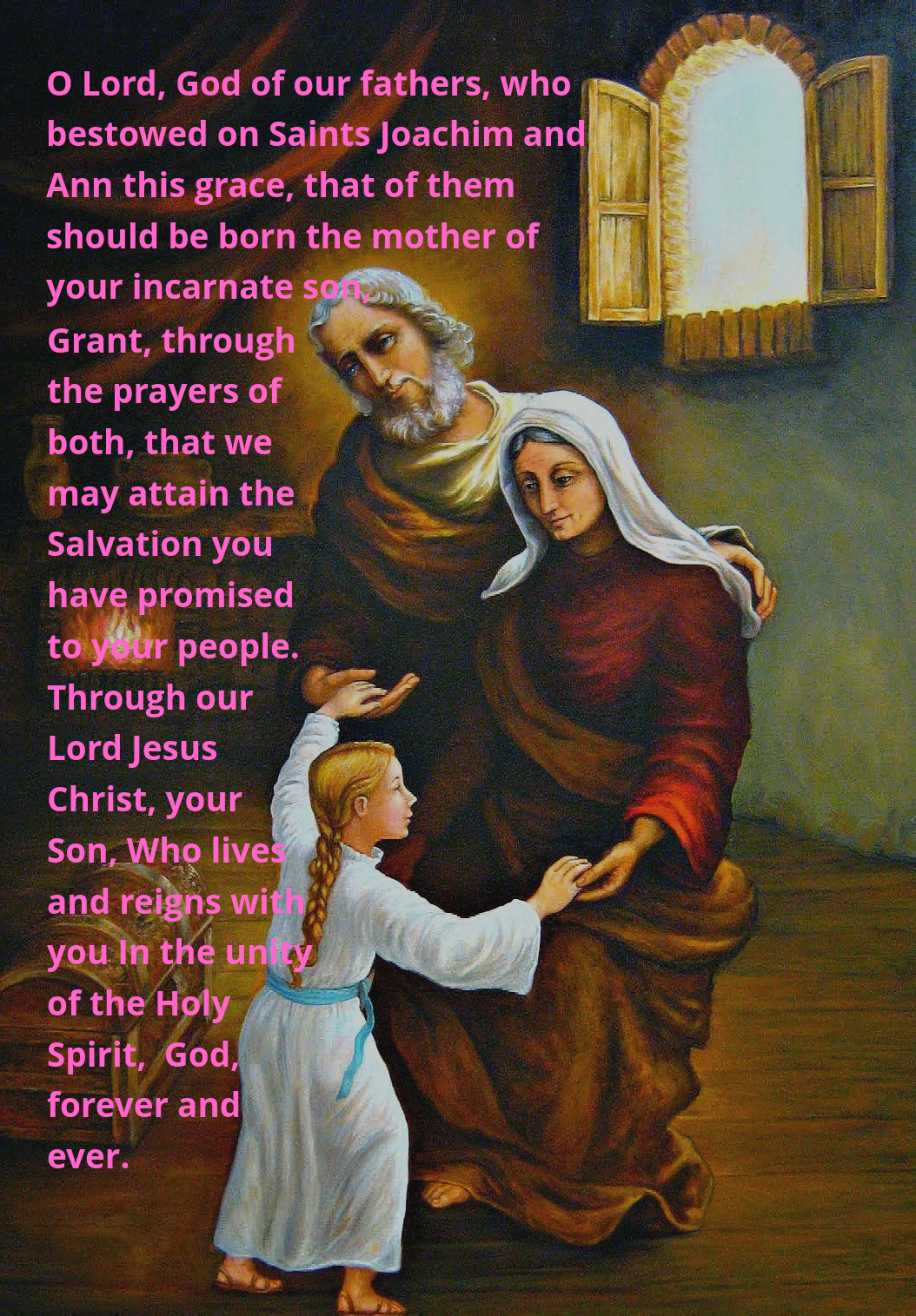
Memorial of Saints Joachim and Anne, Parents of the Blessed Virgin Mary

 Lectionary: 400

His slaves said to him, ‘Do you want us to go and pull them up?’
He replied, ‘No, if you pull up the weeds
you might uproot the wheat along with them.
Let them grow together until harvest;
then at harvest time I will say to the harvesters,
“First collect the weeds and tie them in bundles for burning; but gather the wheat into my barn.”’

 T he farmer's solution is obviously wiser as it allows the wheat to remain in place and mature before the disruption of harvesting and threshing. Hopefully ripe zizania -- a Greek word meaning weeds, darnel, or tares --  can be easily recognized, separated, and burned. Mixed with wheat it can be poisonous. 

The midnight enemy apparently would discredit the farmer's produce by sowing weeds among the wheat, and so gain a market advantage. But the Lord doesn't pursue that side of the metaphor. Rather, he points to the wisdom and thoroughness of the Judgement Day when the Lord's people -- recognized by their just way of life -- will be separated and delivered from the nuisance of wicked neighbors. 

In our time, there are many who simply dismiss all hope and expectation of a final Judgment Day. They do not see the human race surviving until its inevitable geological or astronomical end; and if it comes by way of human mismanagement -- a nuclear holocaust or climactic catastrophe -- it will cause no more harm than the death of billions and the end of human history. Some forms of life will survive and the planet will go on its way -- without purpose or meaning -- until the Sun novas. Apparently they would not lament that doom, since they find no purpose in their life to start with. 

Christians believe and hope for the Kingdom of God; we expect its foundations to be laid in justice and mercy. We have found by way of trial and error, failed experiments, and collapsed societies, that Godless humankind cannot devise such a world. We may occasionally act with justice or mercy, but never with both; and we're usually tending to the needs of the most powerful. They take what they want, demand more, and threaten often; and we've given them the power to carry out their threats. It's not a good system. 

Dear Lord, let your Judgment Day dawn, your Kingdom come, and your will be done! The sooner, the better. 


Friday, July 25, 2025

Feast of Saint James, Apostle

Lectionary: 605 

We hold this treasure in earthen vessels,
that the surpassing power may be of God and not from us.

We can only imagine the chagrin that came over the faces of Saints James and John when they remembered today's gospel passage: "What were we thinking? What did she think Jesus would do to that incredible request?"

At the time, of course, they really had no idea of what would happen in Jerusalem. The Lord's predictions about his being arrested, tried, convicted, tortured, and crucified made no sense to them. His rising from the dead? That must be poetry. Surely, it's nothing we should take literally. The dead do not come back to life. Everybody knows that! It's just nonsense. Everything will be alright. Do you suppose we can sit on his right and left when he comes into this kingdom. There's no harm in asking!" 

The day came when James and John, like the Saints Peter and Paul, had to admit, "we are earthen vessels." Made of dirt, like Adam, as God had said in the Garden of Eden. We thought we were better than that, and the fact that we thought it only proved how foolish mud can be. 

...that the surpassing power may be of God and not from us.

When he taught us, "Hallowed be thy name," he was talking about God and no one else! 

The Apostles did not live to see the entire world become disciples of Jesus. We're not expected to live to see that day either. But we know it will come. That knowledge is our faith and it's just as sure as the hope that encourages us and the love that moves us. We act with confidence despite the discouragement that comes at us from all sides, along with the frustrations of failure and the feeling of futility. 

Sometimes we're discouraged.  Sometimes we're as sluggish as mud. And then we get up and go anyway, because we're needed and expected and we love the Lord. 

Thursday, July 24, 2025

Thursday of the Sixteenth Week in Ordinary Time

 Lectionary: 398

"But blessed are your eyes, because they see,
and your ears, because they hear.
Amen, I say to you, many prophets and righteous people
longed to see what you see but did not see it,
and to hear what you hear but did not hear it."

Those who read, hear, and interpret today's first reading should notice that the lectionary's text differs from that found in the Book of Exodus. Verses 3-8 and 12-15 are not there. I am sure there are reasons for it, but the narrative as we hear it is rather disjointed. 

Adults who have heard and accepted the Gospel are charged with the responsibility of lifelong catechesis. That is, they must be continually learning to see what the Apostles saw, and to hear what they were told. That instruction must include explanations of difficult passages of the Scripture, like that of today's first reading. They should not need to be protected from certain verses, like vs 12: 
"Set limits for the people all around, saying: Take care not to go up the mountain, or even to touch its edge. All who touch the mountain must be put to death."

I remember my parents telling me not to do something under pain of death. I don't suppose they meant that literally, but I took it literally. They meant the warning to be taken very, very seriously. I feared for my life when I violated a parental command. 

Likewise, the Lord's word must be taken seriously. Religion and faith are not options of a free society; they are the commands given to a society that treasures its freedom. Do this and you shall live! 

Catholics in particular should take seriously the practice of our religion; the salvation of the world is at least facilitated by our integrity and faithful zeal. When we hear, "This is my body," we accept the Lord's word as it is. We should want to be there, and be prepared to receive his precious gift. Jesus has made it clear that by eating his body and drinking his blood we become his body and blood. 

And so, when we announce the Word of the Lord and make disciples of all nations, we are also offering our own body and blood for the salvation of the world. The priest says, and all the people amen, "This is my body!" 

Count how fortunate you are that these mysteries, hidden for so long, have been revealed to you. 


Wednesday, July 23, 2025

Wednesday of the Sixteenth Week in Ordinary Time

 Lectionary: 403

Then the LORD said to Moses,
“I will now rain down bread from heaven for you.
Each day the people are to go out and gather their daily portion;
thus will I test them,
to see whether they follow my instructions or not.
On the sixth day, however, when they prepare what they bring in,
let it be twice as much as they gather on the other days.”


The Bread from Heaven, which the Hebrews called manna (meaning, what is it?) was one of the many "mighty works of God" on which our faith is founded. If we set aside God's creation of the Universe, we can remember the first of His mighty works was: parting of the Red Sea, the people's passage across its dry bottom, and the total destruction of the Egyptian army with all its horse, chariots, and charioteer, plus the Pharaoh. 

These mighty works would continue throughout Israel's history as they survived the wilderness for forty years and settled in Palestine despite the hostility of its residents. God had promised the land to their Patriarch Abraham and he would not be denied. From the settlement of Palestine we can add the heroic deeds of the Judges, the capture of Jerusalem, and the history of God's people, including their Babylonian captivity and return to Jerusalem seventy years later. 

Christians claim the greatest work of all is the Resurrection of Jesus Christ, while Catholics believe that Great Work is still manifest in the Eucharist. Indeed, the Life, Death, and Resurrection of Jesus point to the Eucharist as their end and purpose! Our Communion with the Father, Son, and Holy Spirit is so far beyond our human comprehension that we can see it only in the sharing of what appears to be bread and wine. 

And that mighty demonstration finds its prophetic antecedent in the what-is-it? which the hungry Hebrews gathered off the desert ground. 


Tuesday, July 22, 2025

Feast of Saint Mary Magdalene

 Lectionary: 603

On my bed at night I sought him
whom my heart loves–
I sought him but I did not find him.
I will rise then and go about the city;
in the streets and crossings I will seek
Him whom my heart loves.


 G oogle instantly defines street walker as "a sex worker who seeks customers in the street." Sex worker is the new, sanitized euphemism for prostitute

Song of Songs, from which our first reading is taken, describes the ardent street walker's search for God as she rises from her bed to go about the city, seeking the object of her love. There is something outlandish, daring, and risque about the search for God. It's not what normal people do. 

Friar Stephen McMichael, in his book, Mary Magdalene: In Medieval Franciscan Spirituality Beloved Disciple and Apostle of the Apostles, recalls the medieval fascination with "the other woman" in Jesus' life. She was not remembered as an adulteress or prostitute but as a heroic penitent and faithful disciple of Jesus, second only to Mary the Mother of God

Today's critics, predictably, prefer to charge the Church with remembering her as a great sinner. She is the prostitute in Jesus Christ, Superstar, who sings, "I don't know how to love him" while he sleeps in her bed. Because they do not believe in grace or redemption but have no doubt about sin, they cannot see our delight in honoring Saint Mary Magdalene, beloved disciple and Apostle to the Apostles. 

Medieval artists, inspired by the enthusiasm and simplicity of Saint Francis of Assisi, accepted his teachings about penance. He had personally named his disciples as "Penitents from Assisi." They were as fascinated with Saint Mary Magdalene as the twentieth century Church was delighted with Saint Therese de Lisieux. 

Where Therese had little to atone for, Mary Magdalene was a woman with a past. But the friars and their contemporaries had no great interest in salacious details; it was far more rewarding to remember her journey from penance, to enlightenment, to holiness. She was the woman rescued by Jesus in John 8, forgiven in Luke 7, edified at the tomb of Lazarus (John 11), and commissioned as an apostle in John 20. According to ancient legends, she had finished her life as a missionary, miracle worker, and solitary hermit in Marseilles, France. 

She was you and me, a sinner turned to the Lord, redeemed in love, and sent to announce the Good News to the World. Addressing the confusion, Pope Francis updated the Church's reverence for her in giving her a feast day apart from the holy family of Bethany, Saints Martha, Mary, and Lazarus, which is July 29. 


Monday, July 21, 2025

Monday of the Sixteenth Week in Ordinary Time

Franciscan Preacher
Lectionary: 395

Some of the scribes and Pharisees said to Jesus,
"Teacher, we wish to see a sign from you."
He said to them in reply,
"An evil and unfaithful generation seeks a sign,
but no sign will be given it
except the sign of Jonah the prophet.

Those scribes and Pharisees who demanded a sign from Jesus might have done well to study today's first reading from the Book of Genesis. Pharaoh had seen more than a few signs to persuade him of God's authority. Clearly the king of Egypt was no match for the King of Heaven and Earth; but he was headstrong and his arrogance made him stupid. Fear, greed, and lust can do the same thing, as the Scriptures amply demonstrate with many other stories. 

Faith in God begins and ends in an encounter with the Living God. Persuasive arguments have their place; they can help the heart explain to the mind why we're doing this. But they do not persuade a heart enslaved to lesser gods. 

Listening to a video lecture recently, I learned that the great philosopher Georg Wilhelm Friedrich Hegel was the first to show that slaves are more free than their masters, because the slave knows he is dependent upon the master, but the master does not see, understand, or admit that he is more dependent upon his slaves. Arguments and persuasions mean know more to them than colorful images mean to the blind. 

Whereas a slave can be freed by another's decision, the master can be freed only by his own decision. And he is decidedly against making such a decision! He cannot even imagine it, much less see the necessity of it. But the slave can imagine both. To make matters worse, the master's descendants might never recognize how unfree their ancestor was, while the slave's descendants see clearly the bondage that persists from year to year and century to century. (On December 6 of this year, it will 160 years since slavery was abolished in the United States. We were among the last of slave-owning nations to make that decision.) 

The scribes and Pharisees in today's gospel are possessed by their fear that Jesus might be the Messiah, and that God has finally decided to intervene in human affairs. They could not recognize the Visitation when it came. 

  • Wisdom 14:11 Therefore, upon even the idols of the nations shall a visitation come, since they have become abominable amid God's works, snares for the souls of men and a trap for the feet of the senseless.
  • Sirach 2:14  Woe to you who have lost hope! what will you do at the visitation of the LORD! 
  • Luke 19:44 They will smash you to the ground and your children within you, and they will not leave one stone upon another within you because you did not recognize the time of your visitation."


Sunday, July 20, 2025

Sixteenth Sunday in Ordinary Time

Lectionary: 108

Do not neglect hospitality, for through it some have unknowingly entertained angels."

The Book of Genesis recalls Abraham and Sarah’s hospitality to three strangers who visited their encampment. By the time their meal had ended, their kindness was rewarded with the promise of a laughing baby boy despite their old age. Today's gospel also reflects on the virtue of hospitality. Martha prepared the meal, Mary sat at the Lord’s feet, and Jesus served the Word of God. The United States today is faced with the opportunity of hospitality and the limits of our generosity. We are a nation of immigrants; a nation founded on trust in God and Christian principles; and in the course of four hundred years, our generosity has proven its worth time and time again as immigrants brought new vitality, courage, willingness and creativity to the United States. We’re especially grateful to the Irish, German, Polish, and Mexican migrants who brought the Catholic faith to Protestant America. But the American success story has also cost a great deal. It brought idleness, arrogance, and a sense of entitlement. We are risk averse, reluctant to make sacrifices, and see no purpose in suffering. We have also become fascinated with evil. Many people feel like they have exhausted goodness; it’s lost its appeal; it’s not going anywhere interesting or exciting. Let’s be feared, resented, and hostile to other nations. Let’s try wickedness for a while. And so The Wizard of Oz becomes Wicked. We see the allure of evil in dangerous, sometimes fatal, games with alcohol. Young men entertain the Internet with death-defying hobbies as if no one cares whether they live or die. Entertainers employ ear-shattering sound, fire, and smoke to amuse their audiences, and sometimes kill them. Computer games use simulated guns to kill simulated enemy soldiers. We see that fascination with evil in experiments with adultery, open marriage, and many forms of weird sex. And meanwhile, in the real world, getting married and staying married, having children and grandchildren, volunteering, and making sacrifices are passe. If Americans think about eternity and life after death, they forget that Judgment Day must come first, between life and eternal life. Instead, they think all this and heaven too. God is good to us; he’ll always be good to us. He owes us happiness! The Bible has a saying about wealthy people who expect God’s goodness to last forever: “Skin for skin!” When Satan comes before God, the Lord boasts about his man Job. “Have you seen how faithful Job is, and how much he loves the Lord?” “Skin for skin!” Satan says. “He loves you because you’re good to him. He’s your pet. Of course he loves you. He’s no fool. He’ll follow you like a slave and say “Yessir!” or “Oh, thank you sir!” to everything you do. Treat him badly once and see what happens!” “He’s in your hands.” God says. “But spare his life.” The Bible, Jesus, and our Catholic Tradition tells us the proof of our love for God and God’s love for us is what happens when success collapses, when the future is uncertain, when health fails, and medicines don’t help. Do we love God then, or do as Job’s wife said, “Curse God and die!” We should not be fascinated by sin and evil. There’s nothing attractive about them; nor is evil a new synthesis good and bad. The Bible, Jesus, and our Catholic Tradition tells us – rather – to be fascinated by the crucifixion of Jesus. We will find redemption in our suffering, and not in our pleasures. To see the mercy, goodness, and grace of God, look at Jesus' wounds. They are beautiful; mystics describe them as precious gems. Our paintings and sculptures of Jesus always include the five wounds on his hands, feet, and side. We remember his crown of thorns, and the stripes on his back, and his face swollen by slaps and beatings. And the sorrowful eyes that pity those who hate him. These terrible images are beautiful to us for they tell us how deeply, intensely, passionately God loves us. We would not know our Lord and Savior without his crown of thorns. When he says we must take up our crosses and follow him, we might pause. Like Job, we might wonder. “What’s the good of that?” Especially if we believed “All this and heaven too!” But as we suffer our setbacks, missed opportunities, losses, and tragedies; and realize the Lord has never abandoned us, and never will, we learn gratitude. There is nothing better than to be with the One who has suffered for us. The Bible, Jesus, and our Catholic Tradition teach us that the All-Powerful Lord of Heaven and Earth has surrendered all his power, majesty, and authority to a human being; who then surrenders to the greatest enemy of all – to Death. And we should be like them! Our heroes are not those who win every fight and destroy every enemy. We should not seek domination or control; and success may not be worth the cost. Catholics don’t celebrate wars of liberation or conquest; but we do remember the wonderful works of the Lord. He saved us because we could not save ourselves. The Bible, Jesus, and our Catholic Tradition teach us to welcome challenges, distress, and strangers. We go out like our Father Abraham and say,” … if it pleases you, do not go on past your servant. Let some water be brought, that you may bathe your feet, and then rest under the tree…. Let me bring you food so that you may refresh yourselves.” The Letter to the Hebrews reminds us of the how we are to live in this world and makes a reference to that story of Abraham, Sarah, and the three mysterious strangers:

Do not neglect hospitality for through it some have unknowingly entertained angels.
Be mindful of prisoners as if sharing their imprisonment, and of the ill-treated as of yourselves, for you also are in the body.
Let marriage be honored among all and the marriage bed be kept undefiled, for God will judge the immoral and adulterers.
Let your life be free from love of money but be content with what you have, for he has said, “I will never forsake you or abandon you.”
Thus we may say with confidence:
“The Lord is my helper,
I will not be afraid. 
What can anyone do to me?”

Saturday, July 19, 2025

Saturday of the Fifteenth Week in Ordinary Time

Lectionary: 394

When Jesus realized this, he withdrew from that place. Many people followed him, and he cured them all, but he warned them not to make him known.

Archbishop Dominique Mathieu. a Conventual Franciscan Friar, was appointed in February of this year as leader of the only Catholic diocese in Iran. I am told he must seek permission from civil authorities whenever he leaves his residence, whether to take a walk, visit a parish, or bring Viaticum to the dying. 

In the 700 years since Dominican missionaries brought the faith to Iran, Catholicism has appeared and disappeared several times. It has been tolerated at times; suppressed, persecuted, and erased entirely at other times; reestablished again; but never welcomed. The Church there is like Jesus, who 
...will not contend or cry out,
        nor will anyone hear his voice in the streets.
    A bruised reed he will not break,
        a smoldering wick he will not quench,
    until he brings justice to victory.
        And in his name the Gentiles will hope.

My mother reminded her children in the 1950's that Catholics have not always been safe or welcome in the United States. She told us of the Know-Nothing riots that troubled Louisville in the 1850s. The law says we have a right to be here; our dignity says we should play our part and accept our responsibilities as citizens. But we should never forget that those who belong to the Crucified are sojourners in an alien land; we are destined for a distant land. 

Catholic children should learn that today. If any feel stifled by the repressive conformism of American society, they should be invited to practice their non-conformity in ways that are more than play-acting. Those who are eager to confirm to America's regime of clothing, eating, and speaking should at least notice that their parents find nothing cute, charming, or appealing in the latest bizarre fads. 

The drop-out counterculture of the sixties, when I was young, was clearly fake even at the time. They were caricatures of freedom like Peter Pan and Bugs Bunny. I chose my own path of non-conformity by becoming a Franciscan Friar and priest. 

As the demands of sexual liberation and perverse ideology are heard in the street -- "You will be assimilated; resistance is futile" -- Catholics practice the chastity of our Savior Jesus Christ, as married, single, and celibate men and women. 


Friday, July 18, 2025

Friday of the Fifteenth Week in Ordinary Time

Lectionary: 393

I say to you, something greater than the temple is here.
If you knew what this meant, 
I desire mercy, not sacrifice,
you would not have condemned these innocent men.
For the Son of Man is Lord of the sabbath.

 O ur faith, unlike that of the Pharisees, begins with an abiding assurance that the Lord loves us in any and every case. His love is healing, consoling, challenging, and sometimes punishing. We will occasionally be delighted with it; often guided by it; at other times, disappointed; and occasionally profoundly distressed by the thought that the Lord has abandoned us. 

Like the disciples adrift in a stormy sea, we will wonder if he is asleep, or maybe taking a vacation. We will complain of his silence and his absence. And there's no harm in such complaining for he is neither surprised nor disappointed in anything we do. He knows our sin better than we know ourselves; and he believes as we believe, that our faith, love, and hope will see us through. Our nature is to remain faithful, love both affectionately and severely, and to hope in his promise. God knows that about us because we are made in his image. 

Jesus's declaration, "I desire mercy, not sacrifice," sternly reminds us that his Father may be pleased by our sacrifices, but he is not satisfied. We have more to give; we know it; and he knows it; and he knows that we know it. So there is no point in expecting that God should be satisfied with what we have done already. 

Staying out of trouble, supporting the Church, voting our conscience, keeping the vows and promises we have made: these are all good, but never enough. 

And so we do not take leisure, pleasure, or satisfaction as rewards for our accomplishments. Rather we receive these favors because the Lord gives them to us. As the Psalmist says, "He gives to his beloved in sleep." (127:2) Others might insist, "You deserve this!" but we know better. Gifts accepted with gratitude are far more pleasant and satisfying than anything we have earned. 

We should make sacrifices, it's true. But they are a human thing to do. Mercy is divine; and when we show mercy we're acting with a divine impulse, which is itself a gift. We are given the opportunity to make sacrifices; and when we accept these opportunities in a spirit of love, they become divine. 

Pharisees' -- whether contemporaries of Jesus or Christians in today's churches -- suppose that God is or should be satisfied with enough. They say to their hearts, "You have (done) enough to last many years; eat, drink, and be merry.  

They leave space for themselves in their own lives because they secretly believe that love will suffocate them. They cannot imagine living within the chambers of his Sacred Heart and breathing freely. "It's just too tight in there." and refuse to enter. But they are frustrating God's intention for them, and that's never a good thing. 

Mercy proves itself more free, spacious, and life-giving than giving one's own body to be burned


Thursday, July 17, 2025

Thursday of the Fifteenth Week in Ordinary Time

Lectionary: 392

"Come to me, all you who labor and are burdened, and I will give you rest.
Take my yoke upon you and learn from me,
for I am meek and humble of heart;
and you will find rest for yourselves.
For my yoke is easy, and my burden light."

When all else fails," the bumper stickers say, "Pray!" Members of Alcoholics Anonymous generally agree that has been their practice. They tried every possible way to use alcohol with moderation, but that failed. They insisted it wasn't a problem, or the problem, but that failed. So they tried quitting altogether, and that failed. Everything they tried failed. They tried prayer, "Lord, help me stop!" But that failed too. (The Lord doesn't usually work as an assistant or aide to anyone.)

When they finally admitted they were utterly helpless, and nothing they had tried, or might ever try, worked for them; and their only recourse was to confess their helplessness in the face of imminent catastrophe and impending death, they made the desperate decision to turn everything -- meaning Everything -- over to the will of God. Their work, family, health, money, friends, hobbies, idleness: everything belongs to God. 

"We made a decision to turn our will and our lives over to the care of God as we understood Him." The "we" in that sentence includes that isolated individualism which falsely guarantees one's freedom. God's will brings them into fellowship with other alcoholics. 

The next six steps concern their openness to letting go of bad attitudes, mischievous stereotyping, and "stinking thinking." And whenever they find they are holding out in one area of another, they either relapse or surrender that too. (Remember the story of Ananias and Sapphira. Acts 5:1-11)

That search for one's "character defects" -- Catholics call it penance -- is lifelong and must become habitual. The Twelve Step program remolds the character that seemed impervious to change and adaptability. Good habits become virtues with deep roots in one's being. 

Penitents forget neither their sins nor their character defects. They always know they may slip back into the awfulness of their past, even when others can hardly believe the horror stories they tell. They do not promise to remain sober for the rest of their lives for they remain free as God is free. 

But the Lord himself recognizes his own. Penitents -- those who practice the twelve steps, those who practice penance, those who live the Gospel, disciples of Jesus -- become like their Master; they are meek and humble of heart. 

Wednesday, July 16, 2025

Wednesday of the Fifteenth Week in Ordinary Time

Cologne Notre Dame Cathedral

Lectionary: 391

"I give praise to you, Father, Lord of heaven and earth,
for although you have hidden these things
from the wise and the learned
you have revealed them to the childlike.

How does one become childlike? Or, as Nicodemus put it, “How can a person once grown old be born again? Surely he cannot reenter his mother’s womb and be born again, can he?"

Old people sometimes become childlike, but that's not what anyone hopes for, or would wish on their elderly friends and family. 

Some of the greatest scholars and scientists, having contributed brilliantly to their fields, become hostile to new ideas as they age. They hate to be upstaged by younger people who build on, and go further with, their good insights. But every new idea gets old, becomes brittle, and loses some of its luster. 

And we can all act childishly sometimes, when we're disappointed or out of sorts and nothing is going right. That's certainly not the plan. 

Becoming childlike, I think, is learning to set aside the initial reaction of skepticism, and repressing the urge to ironic or sarcastic wit. It's a willingness to wait and see, and let understanding come, if and when it does. 

Pascal, in his Pensees, observed that when someone is wrong about something, they are right from their own perspective. It never hurts to find out what that perspective is before pointing out how wrong their idea might be. There might be something valuable there; and it might not deserve your clever sarcasm. In fact, sarcasm -- which etymologically means cutting flesh -- may be entirely wrong. That is, your wit is worse, and causes more harm, than the bad idea.  

And then, having seen their perspective and how it makes sense to them, if it's still necessary, we might point out the wrongness of the bad idea. If your interlocutor feels respected, they might not mind having a pet idea dismissed. Adults cultivate a curiosity which doesn't respond with irony or skepticism. 

A painting representing
the Holy Trinity
in Cologne Cathedral
France


Children often like new things, places, and ideas; but they don't pretend to know much
. Childlike adults also know they don't know very much. They only know what they know, but they also know there is more to learn in every field of knowledge. Efren (aka, the magician) Reyes is one of the best pool players on earth. He says he likes to learn from young players; they're often trying out new strategies and techniques that he could use. 

In the Spirit of Jesus we are reborn and become childlike. We are open to new learning, but wise enough to honor others who believe in nonsense. 


Tuesday, July 15, 2025

Memorial of Saint Bonaventure, Bishop and Doctor of the Church


 Lectionary: 390

Jesus began to reproach the towns where most of his mighty deeds had been done, since they had not repented.

The Divine Authors of the Bible invested more in God's Mighty Deeds than in the wisdom of proverbs. Chestnuts like "Do good, avoid evil;" and "Do unto others as you would have them do unto you:" have their place in any religion. But they are not the core of our faith.

We believe in God's mighty works; that is, in the clear and obvious interventions in human history. That the Hebrews were delivered out of bondage to a powerful Egyptian pharaoh could not be an accident. That Jesus healed the sick, raised the dead, and was himself raised from the dead after suffering scourging and crucifixion: these were Acts of God. There can be no doubt about it. 

Critics might say none of that ever happened, but no one can prove that something never happened. Our evidence is the eyewitness testimony of those who were there. Plus the courage and credibility of those very witnesses who saw and testified despite the arguments, persuasions, threats, violence, and martyrdom which they encountered. Unlike the "martyrs" of some nations and the "heroes" of others, Christian martyrs never killed anyone. They were only mercilessly slaughtered for saying what they knew to be true. 

The Nicene Creed, written in Nicea seventeen centuries ago, is not a recital of good ideas. It's a record of what we saw and remember. Thomas Jefferson, perhaps the most important of America's Founding Fathers, rejected the entire story of salvation. His "Bible" excludes all of the stories and contains only the teachings which conform to his notions of God and religion. A Jeffersonian nation cannot be called Christian. 

"Jesus began to reproach the towns where most of his mighty deeds had been done, since they had not repented."

 The warning is clear. The urgency is obvious. The time is short. 

Monday, July 14, 2025

Memorial of Saint Kateri Tekakwitha, Virgin

 Lectionary: 389

When Jesus finished giving these commands to his Twelve disciples,
he went away from that place to teach and to preach in their towns. (Matt 11:1)

 S aint Matthew's tenth chapter concludes with the first verse of chapter 11. In context, it is the Lord's words to his disciples as they are setting out on the Gospel Road. They are called apostles in 10:1 and disciples in 11:1. As Apostles they have great authority to heal, drive out demons, and teach. As disciples they must continue to learn from him, for they will never be greater than he.

As they travel to many places, they should also expect hospitality, reassurance, and comfort for the represent the Mercy of God. But they will meet opposition and distress. Be surprised by neither; be grateful for both. Remember Holy Job: We accept good things from the Lord, and should we not accept bad as well. The Lord gives; the Lord takes away. Blessed be the Name of the Lord. 

The missionary and the contemplative seek that kind of equanimity. The former finds it in satisfying work; the latter finds it in study and routine. Both wait upon it in prayer. 

"Let not your hearts be troubled. You have faith in God; have faith in me also." 

There is a time for questioning and "Why is this happening?" Sometimes there are answers. Like, "My attitude has not been good." or "I am trying too hard and expecting too much." or, "I need to 'come away and rest a while." Sometimes we must confess our sins and ask for absolution, and then look for ways to atone the wrong we have done. 

But there are also times when we're sure the fault is not in us. We did the best we could with the understandings we had, and good will come of it. One sows; another reaps. I do not need to know. 

If I expected to see the Kingdom of God rise like sun and be greeted from east and west, I expected too much. And that's okay too.